
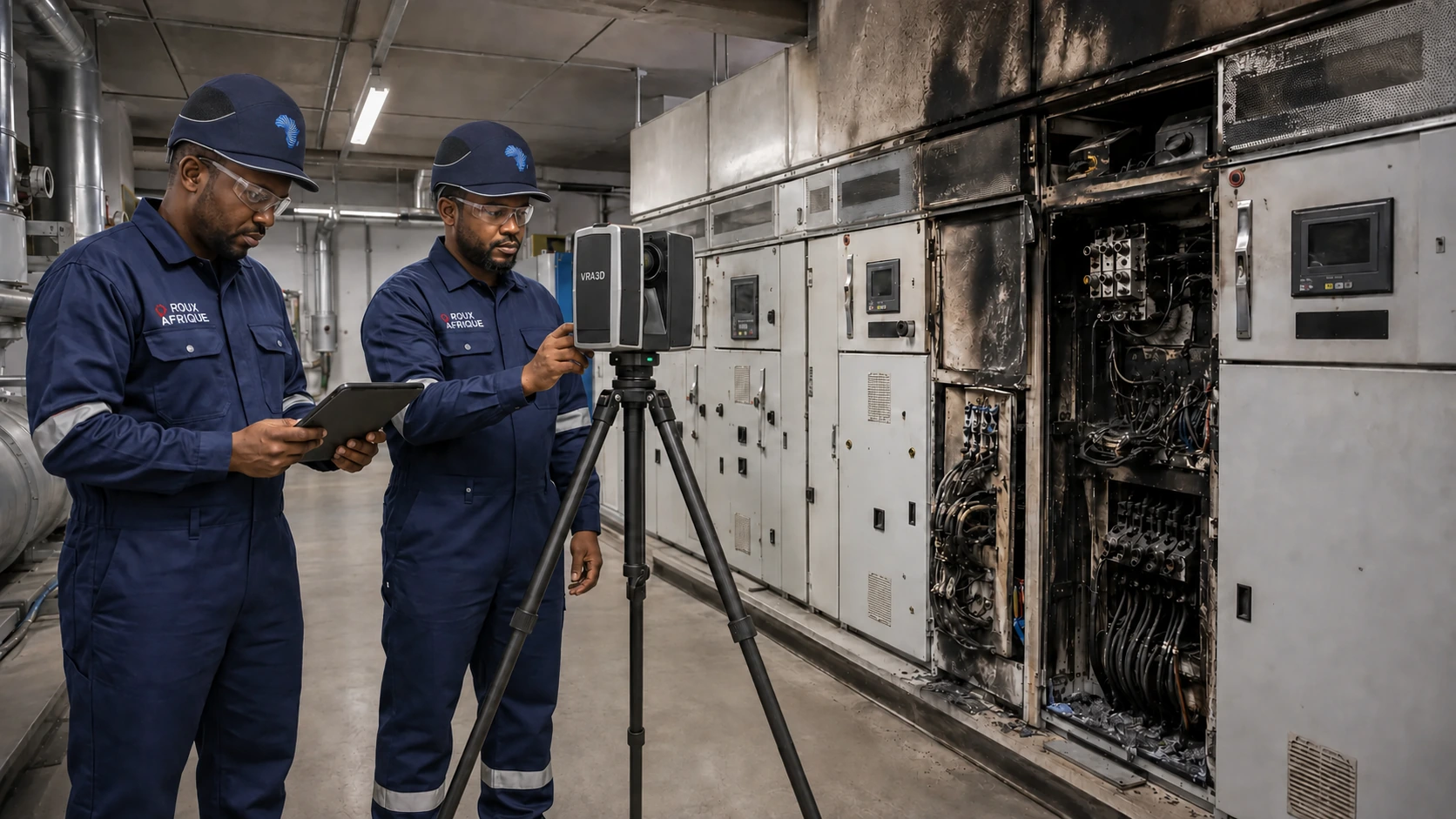
Roux Afrique Claims Adjusters documenting industrial damage

ROUX AFRIQUE CLAIMS · AFRICA & MIDDLE EAST

CLAIMS MANAGEMENT

CLAIMS ADJUSTER · CLAIMS ADVOCACY · TPA

MOBILISE · QUANTIFY · NEGOTIATE · SETTLE

A major loss is not an administrative file

Roux Afrique Claims supports insured companies, industrial groups, institutions and investors facing major or complex losses.

We organise facts, evidence, property damage, business interruption and negotiations through documented settlement. Any TPA authority remains strictly governed by the mandate, jurisdiction and authority matrix.

FROM THE FIRST HOURS

The claim starts before all information is available

After a major event, the company must act quickly without weakening its future claim.

A technically justified expense can become difficult to recover if it is not documented and connected to the loss and policy.

  • protect people and the environment
  • secure facilities and limit deterioration
  • preserve evidence and chronology
  • notify relevant parties
  • maintain critical operations
  • document emergency expenditure
  • plan repair or replacement
  • measure financial consequences

Roux Afrique Claims balances operational urgency, evidential discipline, policy analysis and financial control.

Stakeholders
BoardsCEOCOOCFOIndustrial managementRisk & Insurance ManagersHSEMaintenanceProductionLegalBrokersInsurersReinsurersLoss AdjustersLendersInvestors

THREE DELIVERY MODELS

Responsibilities that must remain distinct

01

Claims Adjuster acting on behalf of the insured

Appointed by the insured to build and advocate a documented claim.

02

Claims Management end-to-end

Operational management from notification through settlement.

03

TPA & Delegated Claims Administration

Delegated administration within a valid legal, contractual and regulatory framework.

The TPA designation grants no implied authority; every power remains subject to the mandate.

CLAIM GOVERNANCE

Eight workstreams for a complex claim

01

Mobilisation, safety & governance

Loss team, decision-makers, approval paths, emergency measures, decision log and initial strategy.

02

Notification & programme architecture

Policies, periods, insured interests, deductibles, limits, extensions, coinsurance, fronting, reinsurance and documentary duties.

03

Evidence preservation & causation

Locations, photographs, exhibits, witnesses, logs, maintenance, analyses, chain of custody and established-fact register.

04

Property Damage

Buildings, machinery, stocks, safeguarding costs, debris removal, transport, erection, testing, salvage, depreciation and betterment.

05

Business Interruption & financial loss

Lost capacity, trends, seasonality, gross profit, savings, ICOW/AICOW, mitigation, repair and ramp-up.

06

Mitigation, repair & recovery

Repair or replacement, temporary solutions, outsourcing, long-lead items, permits, commissioning and critical path.

07

Claim Preparation & negotiation

Statement of Claim, quantum, evidence reconciliation, memoranda, issue register, interim payments and executive decisions.

08

Settlement, closure & lessons learned

Allocation by coverage, agreement and payment tracking, reserved items, recovery, archiving and prevention recommendations.

METHODOLOGY

From event to settlement in nine steps

  1. 01

    Mobilise

    Assemble the team, secure the mandate and establish governance.

  2. 02

    Notify

    Identify policies and record communications.

  3. 03

    Preserve

    Protect people, facilities and evidence while limiting deterioration.

  4. 04

    Establish facts

    Build a sourced chronology and separate facts, statements and assumptions.

  5. 05

    Quantify

    Assess PD, BI, costs and mitigation on explicit bases.

  6. 06

    Document

    Link each item to evidence, calculations, responsibilities and assumptions.

  7. 07

    Challenge

    Test technical, contractual, financial and documentary consistency.

  8. 08

    Negotiate

    Present positions, address gaps and seek a documented agreement.

  9. 09

    Settle & learn

    Track approvals and payments, close the file and capture lessons learned.

Every material amount must link to a fact, damage, calculation basis, supporting document and documented coverage position.

GOVERNANCE BY EXCEPTION

Manage gaps, not document volume

Registers structure amounts, positions, decisions and uncertainties.

01

Claim Register

Initial, updated, agreed, disputed and paid amounts; evidence, owner, status and next action.

02

Claim Issue Register

Party positions, factual and policy basis, financial impact, expected decision and deadline.

03

Decision & Communication Log

Safeguarding measures, approvals, commitments, communications, reservations and provisional agreements.

04

Data Gap & Assumption Register

Missing or conflicting information, assumptions, sensitivity and remediation action.

RECOVERY CASH FLOW

Interim payments should not wait for the entire adjustment

An interim payment request can be prepared when part of the loss is sufficiently evidenced and undisputed.

  • amount requested and relevant coverages
  • items already evidenced
  • committed expenditure and cash-flow requirements
  • reservations on open items
  • supporting evidence
  • reconciliation with earlier interim payments

The payment decision remains with the insurer or authorised party.

CONTROLLED DELEGATION

A TPA framework governed by an authority matrix

The matrix defines what may be executed, recommended, authorised or escalated.

  • claim categories, territories and coverages
  • information-request and expert-appointment powers
  • recommendation, approval and escalation thresholds
  • reserving rules and settlement conditions
  • payment process and antifraud controls
  • sanctions, embargoes and data protection
  • customer complaints and conflicts of interest
  • SLA, reporting, audit rights and business continuity

No authority is presumed; anything beyond delegation is referred to the principal.

DATA ROOM

A structured Data Room from the first hours

Depending on the loss, the team assembles operational, technical, financial and policy records.

  • policies, endorsements, schedules and notifications
  • incident reports, chronology, photographs and videos
  • drawings, diagrams, SCADA/DCS, alarms and event logs
  • authority reports, causation analyses and maintenance records
  • Asset Registers, Statement of Values and purchase invoices
  • quotes, orders, invoices, payments and timesheets
  • stock, production, sales, budgets and forecasts
  • management accounts, BI calculations and mitigation measures
  • supplier and customer contracts and reconstruction programme
  • minutes, issue registers and agreements

Access is governed by data sensitivity, confidentiality and party rights.

INDEPENDENT QA/QC

Independent review before submission

The review tests factual, technical, financial, policy and documentary coherence.

  • mandate compliance and chronology consistency
  • source traceability and separation of facts and assumptions
  • causation for each claim item
  • absence of double counting
  • quantities, unit prices, taxes and currencies
  • salvage, depreciation and betterment
  • PD and BI consistency
  • savings, mitigation, ICOW and AICOW
  • deductibles, limits and sublimits
  • interim-payment calculations and version reconciliation
  • Statement of Claim and appendix consistency
  • qualification of uncertainty and independent review

A claim is not presented as final while material investigations or decisions remain open.

DIGITAL EVIDENCE

Inventys® and VRA3D supporting traceability

Technology organises and spatialises evidence without deciding coverage.

01

Inventys®

Structures the claim file and its progress.

  • items, evidence and damaged assets
  • costs, responsibilities and open issues
  • versions, interim payments and amounts
  • closure evidence and multi-site consolidation
02

VRA3D

Creates a spatial record of the loss.

  • site configuration and damaged areas
  • equipment location
  • visible extent of damage
  • progress and changes during the works

VRA3D does not replace testing, causation analysis or specialist inspection.

DELIVERABLES

Deliverables designed to advance settlement

Depending on the mandate:

  • 01Immediate Action Plan
  • 02Claims Management Protocol
  • 03consolidated chronology
  • 04Coverage & Notification Matrix
  • 05Claim Strategy Memorandum
  • 06Evidence Preservation Register
  • 07Property Damage Assessment
  • 08Business Interruption Assessment
  • 09Mitigation Register
  • 10Statement of Claim
  • 11Claim Register & Claim Issue Register
  • 12Data Gap & Assumption Register
  • 13interim-payment submissions and supporting files
  • 14negotiation presentations and periodic reports
  • 15financial dashboard and photographic file
  • 16claim–agreement–payment reconciliation
  • 17Settlement & Closure Report
  • 18lessons learned and recommendations

DECISIVE MOMENTS

When should Roux Afrique Claims be mobilised?

  • immediately after a major loss
  • when business continuity is threatened
  • when several sites, countries, policies or insurers are involved
  • for coinsurance or international programmes
  • when causation or quantum is complex
  • when a material interim payment must be prepared
  • when expert discussions stall
  • when an old or blocked claim must be restructured
  • to outsource a claim portfolio
  • before closing items that remain reserved

Late mobilisation may remain possible but cannot recreate evidence that was not preserved.

SECTOR EXPERTISE

Losses requiring specialised expertise

Teams are assembled around damage type, technology, coverage, financial stakes and jurisdiction.

Energy & UtilitiesOil, Gas & PetrochemicalsMining, metals & materialsIndustry & ManufacturingAgri-industryInfrastructureTransport, ports & logisticsTelecommunications & Data InfrastructureReal estate, hospitality & major portfoliosHealthcare & critical servicesConcessions & PPPFinancial institutionsMulti-site portfolios

Technical and financial depth is calibrated to the actual significance of the claim.

DISTINCT EXPERTISE

A responsible mandate. Distinct scopes.

01

Roux Afrique Claims

Structures facts, evidence, damage, loss, claim submissions and post-loss negotiations.

02

Roux Afrique EVS — Valuation

Provides reconstruction or replacement bases when appointed; a pre-loss value does not automatically determine indemnity.

05

Roux Afrique Advisory

Addresses programme architecture, Risk Financing and governance; Claims manages the event once it has occurred.

06

Roux Cyber & legal counsel

Roux Cyber acts as Cyber Claims Adjuster and coordinates specialist digital investigation; legal opinions, litigation and arbitration remain with authorised counsel.

FRAMEWORKS

Frameworks applied to the market and mandate

The policy, endorsements, applicable law, facts and authorised decisions remain decisive.

  1. 01CIMA Code where applicable
  2. 02national insurance regulation
  3. 03programme contractual rules
  4. 04market Claims Management Principles
  5. 05coinsurance and Claims Agreement procedures
  6. 06rules governing TPAs or Delegated Claims Administrators
  7. 07sanctions, KYC and antifraud requirements
  8. 08accounting, tax and data-protection rules

Reference to a market standard grants no licence.

An advisory mandate creates no regulated decision or payment authority.

FREQUENTLY ASKED QUESTIONS

Understand the mandate before acting

How does the insured's Claims Adjuster differ from the insurer's adjuster?

The former supports the insured in preparing and advocating the claim; the latter acts under the insurer's mandate.

Does Roux Afrique Claims decide coverage?

No, except under an explicit and valid delegation. Under an insured-side mandate, the insurer decides coverage.

Can the mandate run through settlement?

Yes. It may include quantification, negotiation, agreement tracking and payment reconciliation; payment authority remains with the authorised party.

Does Roux Afrique Claims negotiate with reinsurers?

It may support technical presentations where the programme and mandates permit, without presuming a direct right of the insured.

How do Claims Management and TPA differ?

Claims Management governs the file; TPA requires a delegation defining authority, limits and oversight.

When should a loss be notified?

As soon as the policy, law and circumstances reasonably allow; missing details may be supplemented later.

Must every expense await prior approval?

Urgent safety measures should not be delayed, but must be documented and notified under the policy.

Can an interim payment be requested?

Yes, when part of the loss is evidenced, subject to approval by the authorised party.

How is betterment handled?

It is isolated and assessed against policy terms, technical necessity, depreciation and regulatory requirements.

How is Business Interruption calculated?

From the actual loss, financial data, trends, savings, mitigation and policy wording.

Does Roux Afrique Claims replace legal counsel?

No. It addresses technical, financial and insurance matters; legal opinions remain with authorised counsel.

Can an old or stalled claim be recovered?

Yes, subject to available evidence, by reconstructing facts, amounts, positions and blockages.

CLAIMS MANAGEMENT & TPA

A credible claim rests on the strength of its evidence

Share the event, policies, first actions, apparent damage and operational impact. We will define the appropriate governance, expertise, evidence strategy and negotiation framework.

Speak with Roux Afrique Claims