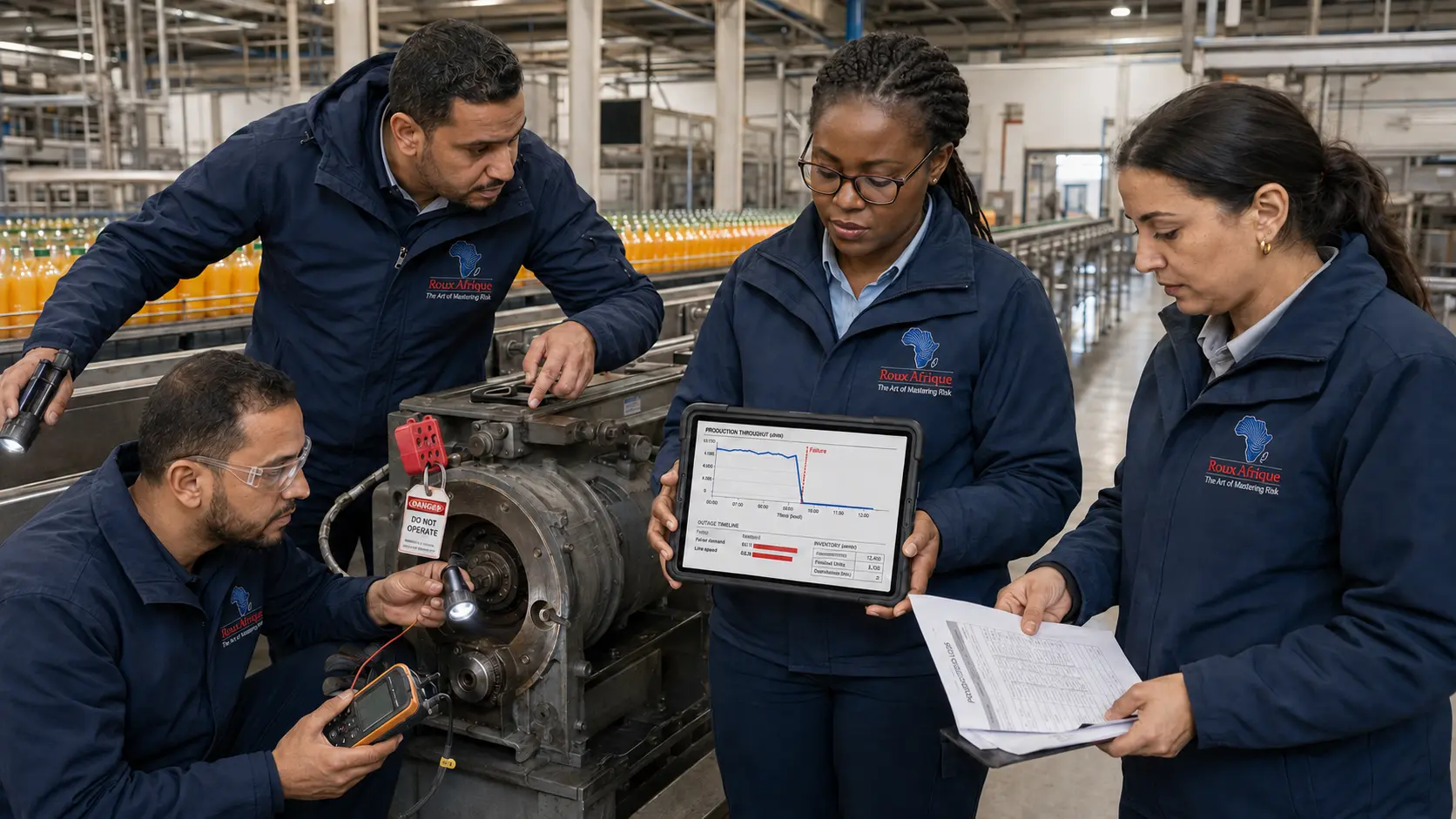
Roux Afrique specialists analysing Business Interruption values, operational dependencies and recovery scenarios

ROUX AFRIQUE EVS · AFRICA & THE MIDDLE EAST

BUSINESS INTERRUPTION

PRE-LOSS VALUES & EXPOSURES

ANTICIPATE · QUANTIFY · SECURE

An asset's value does not measure the value of the operations it supports

Roux Afrique EVS conducts Business Interruption Valuation & Exposure Studies designed to substantiate, before a loss, Business Interruption values, recovery assumptions and critical dependencies.

At the intersection of finance, operations and engineering, the engagement connects the insurance wording, financial records, budgets, production capacity and the recovery critical path within a documented, traceable and updateable BI Values Schedule.

BUSINESS INTERRUPTION EXPOSURE

Insuring the assets without modelling the interruption leaves earnings exposed

Rebuilding a building or replacing a machine is not always sufficient to restore production, sales and the expected level of earnings immediately.

Investigations, permits, long-lead equipment, freight, customs, installation, testing, requalification, ramp-up, inventory replenishment and commercial recovery can extend the financial consequences well beyond physical reinstatement.

A BI value copied directly from the income statement or updated by applying a simple percentage may overlook:

  • The policy's precise definition of Gross Profit
  • Expenses expressly insured or uninsured
  • Growth, seasonality and changes in the business mix
  • Interdependencies between sites
  • Critical suppliers, customers, utilities and logistics corridors
  • Alternative capacity and mitigation costs
  • The time required to return to the expected level of operations

A structured analysis makes it possible to:

  • Substantiate declared BI values
  • Document Insurable Gross Profit
  • Provide a technical view of the Maximum Indemnity Period to be considered
  • Identify bottlenecks and single points of failure
  • Test mitigation measures and Increased Cost of Working
  • Strengthen information supplied to insurers and reinsurers
  • Create, before a loss, a calculation trail that can be reconciled and reproduced

The engagement substantiates declarative data and decision-making assumptions. It does not guarantee that an event will be covered, the amount of any indemnity or a reduction in premium.

Stakeholders
CEOsCFOsCOOsFinance and Technical LeadershipRisk ManagersInsurance ManagersSupply Chain ManagersBrokersInsurersReinsurers

SIX DECISIVE QUESTIONS

Six questions to answer before declaring a Business Interruption value

  1. 01

    WHICH WORDING?

    Gross Profit, Gross Revenue, Gross Earnings, Fees, Rent Receivable or another basis defined by the policy or proposed policy.

  2. 02

    WHICH VALUE?

    A projected value incorporating financial data, growth, seasonality, exchange rates, new capacity and the expected development of the business.

  3. 03

    WHICH PERIMETER?

    A clearly identified legal entity, site, activity, product, production line, currency and reference period.

  4. 04

    WHICH SCENARIO?

    An event, the assets affected, the loss of capacity, a duration and explicitly defined mitigation assumptions.

  5. 05

    HOW LONG?

    The full critical path from the event through to the level of operational and financial recovery adopted in the analysis.

  6. 06

    WHICH MITIGATION?

    Inventories, alternative capacity, outsourcing, production transfers, rental solutions, substitute purchases, expedited logistics and other measures that can genuinely be deployed.

SIX COMPLEMENTARY ANALYSES

Six analyses connecting the wording, financial records and operations

01

Insurable Gross Profit & BI Values

Reconciliation of historical accounts, trial balances, budgets, forecasts and management information against the policy definitions.

The engagement identifies relevant income, insured expenses, Uninsured Working Expenses, standing charges, intercompany flows and the adjustments required to establish a documented BI value by entity, site, activity and currency.

02

Maximum Indemnity Period Review

Analysis of the time required to rebuild, replace, reinstall, test, recommission and regain the expected level of operations.

The Maximum Indemnity Period is reviewed by scenario and through sensitivity analysis. It should not be confused with the policy period, the physical repair period alone or a Recovery Time Objective.

03

Operational Dependencies & Bottlenecks

Identification of processes, equipment, utilities, shared functions and infrastructure whose failure could interrupt multiple operations or sites.

The analysis considers residual capacity, redundancies, buffer stocks, standby equipment, critical spares, transfer options and substitution lead times.

04

Contingent Business Interruption

Mapping of critical suppliers, customers, subcontractors, contract manufacturers, logistics platforms, ports, warehouses and other third parties.

For each dependency, the analysis considers the volumes involved, financial contribution, location, alternatives, qualification lead times and exposure concentrations.

05

Scenario-Based BI Modelling

Prospective quantification of the financial consequences of defined scenarios: capacity loss, monthly production profile, reduction in sales, earnings exposure and recovery trajectory.

Unmitigated economic impacts, the effects of mitigation measures and the analysis incorporating contractual parameters are presented separately.

06

ICOW, AICOW & Mitigation Economics

Assessment of solutions capable of reducing the interruption:

  • Temporary outsourcing
  • Production transfers
  • Rental of equipment or premises
  • Substitute purchases
  • Expedited transport
  • Overtime
  • Temporary installations
  • Temporary relocation

Increase in Cost of Working — ICOW and Additional Increase in Cost of Working — AICOW are addressed separately. Whether they are recoverable depends on the wording, the economic test, the applicable conditions and sub-limits.

CONTRACTUAL BASIS

Insurable Gross Profit is a contractual construct

The income statement is an essential source. On its own, it does not determine the insurance basis.

01

Gross Profit — Insurable Gross Profit

Insurable Gross Profit is established in accordance with the definition and formula in the policy or proposed policy.

It does not automatically correspond to accounting gross margin, EBITDA, net profit or revenue.

02

Gross Revenue, Gross Earnings, Fees or Rent Receivable

Some activities or jurisdictions use other bases of indemnity. Their scope, projection method and declaration rules must be addressed separately.

Where the wording has not yet been finalised, several bases may be modelled, but each remains clearly identified as an assumption to be reconciled with the future policy.

03

Uninsured Working Expenses

Uninsured Working Expenses — UWE are expenses expressly designated as uninsured by the policy.

An expense that is economically variable is not automatically an uninsured expense. Its treatment must be reconciled with the wording and its actual behaviour in the event of an interruption.

04

Expense savings

Savings that may arise from an interruption are a separate concept from UWE defined before a loss.

The pre-loss study may model their probable behaviour, but only the post-loss analysis will establish the savings actually achieved.

Projections and periods exceeding twelve months

A value applicable to a Maximum Indemnity Period of 18, 24, 36 months or longer should not be produced by mechanically multiplying the latest annual value.

The projection should take account, in particular, of:
  • Seasonality
  • Expected growth or contraction
  • Inflation
  • Prices and volumes
  • Exchange rates
  • Contracts won or lost
  • New capacity
  • Closures or planned shutdowns
  • The recovery trajectory

Any pro-rating rule, uplift or declaration-linked mechanism is applied only where the corresponding wording provides for it.

BI VALUES SCHEDULE

A BI Values Schedule is more than a consolidated figure

The BI Values Schedule, sometimes referred to as a BI Statement of Values, may structure values by:

  • Legal entity
  • Country and site
  • Activity, product or service
  • Production line or operating unit
  • Contractual basis
  • Reference date and currency
  • Maximum Indemnity Period
  • Historical and projected value
  • Growth, seasonality and exchange-rate assumptions
  • Insured expenses and UWE
  • Critical dependencies
  • Source, method and level of documentation

For a multi-site group, intercompany flows are identified and eliminated where necessary to prevent double counting.

The BI Values Schedule remains strictly separate from the Property Damage Statement of Values, which presents buildings, machinery, equipment and other physical assets.

MAXIMUM INDEMNITY PERIOD

The Maximum Indemnity Period should cover a critical path, not a market convention

  1. 01

    STABILISATION & INVESTIGATION

    Site access, loss-mitigation measures, technical investigation, debris removal and any required remediation.

  2. 02

    DESIGN & AUTHORISATIONS

    Design, engineering, permits, regulatory requirements, consultations and tender processes.

  3. 03

    PROCUREMENT & MANUFACTURE

    Selection of solutions, placing orders, manufacturing long-lead equipment, and the availability of parts and materials.

  4. 04

    FREIGHT, CUSTOMS & WORKS

    Transport, customs clearance, logistics access, reconstruction, erection and installation.

  5. 05

    TESTING & COMMISSIONING

    Testing, inspections, commissioning, regulatory qualification, and product or customer validation where required.

  6. 06

    RAMP-UP & COMMERCIAL RECOVERY

    Progressive ramp-up, inventory replenishment, restoration of flows and recovery of the expected commercial level where included in the contractual basis.

The repair period, interruption period, recovery time, Recovery Time Objective — RTO, Maximum Tolerable Period of Disruption — MTPD and Maximum Indemnity Period serve different purposes.

Business Continuity indicators may inform the analysis. They do not replace the time limit defined by the policy.

INTERDEPENDENCIES

A remote dependency can stop an undamaged site

Depending on the engagement, the interdependency analysis covers:

  • Relationships between upstream and downstream sites
  • Shared utilities: power, water, steam, cooling, gas and fuel
  • Shared IT, OT and telecommunications platforms
  • Critical suppliers of materials, components and services
  • Strategic customers or offtakers
  • Contract manufacturers and subcontractors
  • Ports, corridors, warehouses and logistics platforms
  • Specialist repairers and equipment manufacturers
  • Authorisations, certifications and scarce skills
  • Available inventory and time to stockout
  • Alternative capacity and qualification lead times

Dependencies involving suppliers, customers, utilities, denial of access or interruption without physical damage may require specific extensions or dedicated cover.

No cover is presumed. The trigger, peril, damage requirement, designation of third parties, their tier within the supply chain, territorial scope, time deductible, limits and sub-limits must be reviewed in the applicable policy.

Digital scenarios and cyber-related interruptions fall within the remit of Roux Cyber, with financial input from EVS where this is included in the engagement.

METHODOLOGY

A financial, operational and technical methodology

  1. 01

    DEFINE

    Define the purpose, entities, sites, activities, reference date, currencies, contractual bases, Maximum Indemnity Period, inclusions, exclusions and responsibilities.

  2. 02

    TRANSLATE THE WORDING

    Build a matrix linking policy definitions to financial line items: bases of value, UWE, payroll treatment, ICOW, AICOW, deductibles, extensions, limits and sub-limits.

    This is a technical interpretation and does not constitute legal advice on coverage.

  3. 03

    COLLECT & RECONCILE

    Review financial statements, trial balances, budgets, forecasts, monthly management reports, sales, volumes, prices, costs, inventories, intercompany flows and other relevant data.

    The data is reconciled without presenting the engagement as a statutory or financial audit.

  4. 04

    PROJECT THE BUSINESS

    Incorporate trends, seasonality, inflation, exchange rates, capital expenditure, new capacity, contracts, closures and changes in the business mix.

  5. 05

    MAP OPERATIONS

    Connect revenue to the sites, production lines, equipment, utilities, inventories, suppliers, customers and infrastructure on which it depends.

    Bottlenecks, interdependencies and alternative capacity are identified.

  6. 06

    BUILD THE CRITICAL PATH

    Model a realistic sequence covering stabilisation, design, authorisations, procurement, reconstruction, installation, testing, recommissioning and ramp-up.

  7. 07

    MODEL & CHALLENGE

    Quantify unmitigated and mitigated scenarios, test sensitivities and challenge the results against physical capacity, financial data and recovery assumptions.

    Economic losses and their translation incorporating contractual parameters are distinguished.

  8. 08

    VALIDATE & UPDATE

    Submit material assumptions to Finance, Operations, Engineering, Maintenance, Supply Chain, Commercial and Insurance leadership.

    Following the draft version and resolution of documented comments, the final deliverables are issued with an updating protocol.

Methodological signature

Every BI value must be linked to a wording, an entity, a period, a currency, a source, an assumption and a recovery scenario.

DATA ROOM

A Data Room proportionate to the complexity of the business

Depending on the engagement, the data sought includes:

  • Policy, Schedule, endorsements and previous BI declarations
  • Limits, sub-limits, deductibles and contractual periods
  • Historical financial statements, trial balances and chart of accounts
  • Budgets, forecasts and monthly management reports
  • Sales, volumes, prices and margins by site, activity or product
  • Expenses, payroll and intercompany flows
  • Production, capacity, yields and constraints
  • Inventory levels and work in progress
  • Long-lead equipment and strategic spares
  • Critical suppliers, customers and utilities
  • Logistics routes and alternative solutions
  • Business Continuity Plans, interruption history and existing scenarios
  • Capital expenditure programmes and planned changes in scope

Every missing item is recorded. Its impact, the replacement assumption and the corresponding confidence level are explicitly stated.

QA/QC

Quality control that rejects shortcuts

The QA/QC process covers, in particular:

  • Reconciliation of calculations against financial statements and budgets
  • Traceability of the mapping between wording and chart of accounts
  • Substantiation of insured and uninsured expenses
  • Distinction between UWE and expense savings
  • Elimination of intercompany flows and double counting
  • Consistency of currencies, rates and dates
  • Consideration of seasonality, inflation and growth
  • Reconciliation of physical capacity, volumes and revenue
  • Validation of lead times and the critical path
  • Challenge of ramp-up and mitigation assumptions
  • Control of multi-site aggregations
  • Distinction between BI Values, economic exposure, BI EML/PML and contractual parameters
  • Independent review of formulas and material assumptions
  • Management of versions, qualifications and missing data

An engagement cannot be issued where its contractual basis, perimeter, formulas or scenarios are not sufficiently defined to support a responsible conclusion.

INVENTYS® · VRA3D

Inventys® and VRA3D supporting data continuity

Technology strengthens the structure, traceability and technical record of the engagement.

01

Inventys®

Inventys® structures the financial, operational and insurance data used during the engagement.

  • BI Values Schedule
  • Multi-entity and multi-site consolidation
  • Mapping between financial data and contractual bases
  • Traceability of sources and assumptions
  • Scenario and sensitivity management
  • Variance tracking
  • Version control
  • Future updating cycles
02

VRA3D

Where the site configuration warrants it, VRA3D helps to document critical assets, flows, bottlenecks, utilities and reconfiguration options spatially.

  • Understanding dependencies
  • Scenario workshops
  • Remote review of the recovery path

VRA3D is used only where it adds genuine technical value to the engagement. Technology strengthens the analysis; it does not replace validation by Finance and Operations or the experts' professional judgement.

DELIVERABLES

Deliverables designed for decision-making and underwriting

Depending on the engagement:

  • 01Executive BI Exposure Memo
  • 02Business Interruption Assessment Report
  • 03BI Values Schedule by entity, site, activity and currency
  • 04Reconciliation bridge between financial statements and BI values
  • 05Insurable Gross Profit calculation workbook
  • 06Uninsured Working Expenses schedule
  • 07Maximum Indemnity Period analysis
  • 08Recovery Critical Path
  • 09Interdependency and bottleneck map
  • 10CBI Dependency Register
  • 11Scenario Book with recovery curves and sensitivities
  • 12ICOW and AICOW options register
  • 13Reconciliation against currently declared values
  • 14Data Gap & Assumption Register
  • 15Structured and reproducible Excel database
  • 16Annual and event-driven updating protocol
  • 17Validated draft and final versions

DECISION POINTS

When should a Business Interruption study be commissioned?

  • Before renewal or restructuring of a PDBI programme
  • Where BI values are based on outdated or insufficiently documented data
  • Following an acquisition, expansion, new production line or site closure
  • Following a material change in revenue, margins or the business mix
  • Following a major change in the supply chain
  • Where an insurer or reinsurer requests substantiation of BI values
  • Where long-lead equipment or logistics constraints have changed
  • To consolidate a multi-site or multinational portfolio
  • Ahead of financing, refinancing or an M&A transaction
  • Following the identification of new dependencies or bottlenecks
  • Where the Maximum Indemnity Period has never been subject to documented analysis

Updating should also be triggered by any material change affecting revenue, expenses, capacity, dependencies, currencies or recovery times.

CRITICAL ENVIRONMENTS

Sectors where a few hours can place months of earnings at risk

Sectors served:

Energy & UtilitiesOil, Gas & PetrochemicalsMining, Metals & MaterialsIndustry & ManufacturingAgro-industryInfrastructureTransport, Ports & LogisticsTelecommunications & Digital InfrastructureReal Estate, Hospitality & Income-Producing Property PortfoliosHealthcare & Critical ServicesInvestors & Financial Institutions

Our experts operate across Africa, the Maghreb and the Middle East, incorporating the realities of each location: imported supplies, local substitution capacity, freight, customs, skills availability, infrastructure, currencies and regulatory lead times.

CLEAR RESPONSIBILITIES

One accountable mandate. Distinct areas of expertise.

01

Business Interruption — Roux Afrique EVS

Establishes, before a loss, BI values, projections, dependencies, the recovery path and prospective scenario quantification.

02

Insurable Asset Valuation

Determines the reconstruction or replacement values of buildings, installations, machinery and other tangible assets. Its SOV remains separate from the BI Values Schedule.

03

Physical Inventory & Asset Register

Identifies and characterises assets. It may inform the BI analysis without determining Insurable Gross Profit or the Maximum Indemnity Period.

04

Engineering Risk Survey

Analyses hazards, protection measures, vulnerabilities and physical scenarios. It provides the technical inputs required for EML, PML or MFL scenarios, whose BI component may be valued through this engagement.

The maximum BI scenario may differ from the maximum Property Damage scenario. EML, PML, MFL, SMP and SME must be defined in the engagement letter.

05

Roux Afrique Advisory

Reviews programme architecture, limits, deductibles, retentions, the Limit of Indemnity where applicable, Risk Financing and renewal strategy.

Roux Afrique EVS supplies the values and technical analyses without carrying out a regulated placement activity.

06

Roux Afrique Claims

After a loss, establishes the loss actually sustained, savings achieved and increased costs incurred, structures the documented claim and supports its defence within the scope of its engagement.

The pre-loss EVS study does not predetermine the quantum of a future claim.

07

Roux Cyber

Analyses digital scenarios, cyber resilience and interruptions involving information systems and OT environments.

REFERENCES

References applied without confusing their respective purposes

The policy, its endorsements, applicable law and the facts of any loss remain decisive in determining coverage and indemnity.

  1. 01Financial statements and management information provide the documentary basis for the calculations
  2. 02Wordings and technical guidance from the relevant markets may inform definitions, methodologies and required data
  3. 03ISO 22301 and ISO/TS 22317 may support continuity analysis, the Business Impact Analysis and recovery objectives
  4. 04The findings of an Engineering Risk Survey may provide the scenarios and technical lead times required
  5. 05Relevant local professional practices are incorporated where appropriate

Business Continuity standards determine neither Insurable Gross Profit, coverage nor the contractual Maximum Indemnity Period.

No generic standard, accounting formula or market practice is a substitute for reviewing the wording and the actual operating model.

FREQUENTLY ASKED QUESTIONS

Understanding pre-loss Business Interruption analysis

What is a pre-loss Business Interruption study?

It is an engagement designed to establish and document the financial values exposed to interruption, critical dependencies and recovery assumptions before a loss occurs.

What is the difference between revenue, accounting margin and Insurable Gross Profit?

Revenue measures sales. Accounting margin follows the organisation's financial-reporting rules. Insurable Gross Profit is constructed using the definitions, line items and formulas in the policy.

How are BI values established?

From the wording, financial statements, budgets, projections, insured or uninsured expenses, intercompany flows, Maximum Indemnity Period, scenarios and the operational characteristics of the business.

Does a twenty-four-month period mean that the annual value should be doubled?

Not automatically. The projection should incorporate seasonality, growth, prices, volumes, exchange rates, new capacity and the recovery trajectory in accordance with the applicable wording.

How is the Maximum Indemnity Period determined?

By analysing the full critical path: stabilisation, design, authorisations, procurement, reconstruction, long-lead equipment, transport, installation, testing, ramp-up and return to the expected level of operations.

Does the Business Continuity Plan's RTO correspond to the indemnity period?

No. The RTO is a management objective for recovery to a defined level. The Maximum Indemnity Period is a contractual time limit that should be reviewed against realistic scenarios.

Does the engagement cover critical suppliers and customers?

It may identify and quantify these dependencies where the engagement includes CBI. Their coverage remains subject to the policy's extensions, triggers, designations, territorial scope, limits and exclusions.

How does it differ from an Engineering Risk Survey?

The Engineering Risk Survey selects and qualifies physical scenarios, vulnerabilities and technical lead times. The BI study translates their financial consequences using explicit assumptions.

How does it differ from a post-loss assessment?

The Roux Afrique EVS study is preventive and prospective. Following a loss, quantification of the loss actually sustained and preparation of the claim fall within the remit of Roux Afrique Claims.

Does the study guarantee a future indemnity?

No. Estimates are made as at a specified date using the information available and documented assumptions. Any indemnity remains subject to the insured event, causation, definitions, exclusions, deductibles, limits, sub-limits and the other conditions of the applicable policy.

SUBSTANTIATE THE EXPOSURE

A material financial exposure deserves more than a percentage applied to revenue

Share your wording, current BI values, principal financial data, sites and recovery assumptions with us. Roux Afrique EVS will structure the scope, analyses and deliverables required for a documented, traceable and updateable Business Interruption declaration.

Speak with Roux Afrique EVS