An asset can only be managed effectively when it is identifiable, locatable and linked to a verifiable source
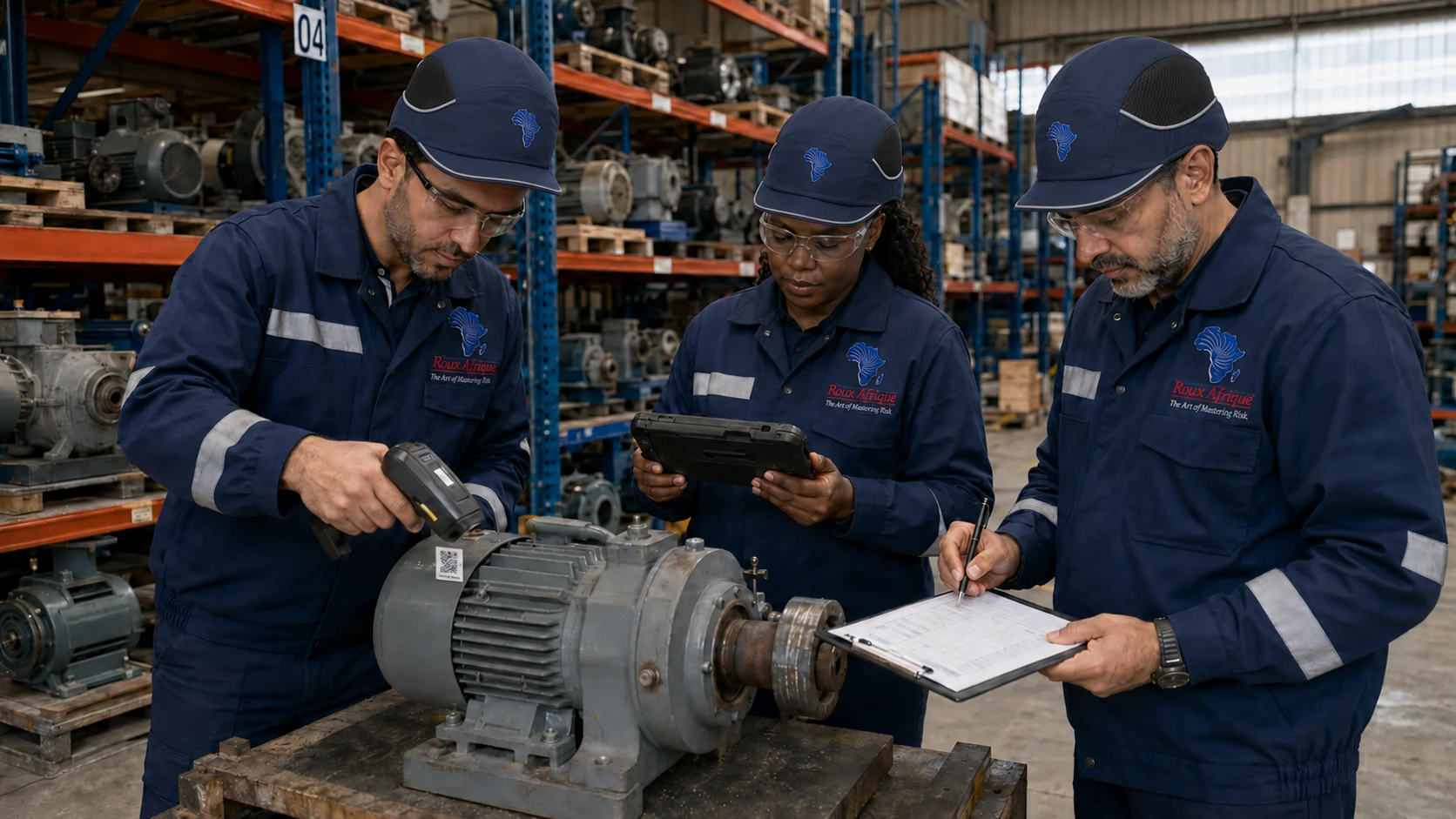
Roux Afrique EVS performs physical inventories of tangible fixed assets and builds structured Operational Asset Registers that reconcile field reality with Finance, Operations, Engineering, Maintenance and Insurance records.
At a defined reference date, each in-scope asset is associated—subject to the agreed granularity—with an identity, location, class, status, verification evidence and source-system identifiers.
Exceptions are isolated, documented and submitted for validation. They are never corrected silently.
Assets on site. Records that do not always reflect the same reality.
An Accounting Fixed Asset Register describes what the systems have recorded. Fieldwork reveals what exists, what has been moved, replaced, modified, shut down or removed.
Over time, discrepancies may arise from:
installed equipment that has not been recorded individually
accounting entries grouping several physical assets
one asset spread across several accounting entries
replacements completed without identifying the replaced item
transfers between sites, entities or cost centres that were not adequately documented
capital work in progress already placed in service
assets physically removed but still recorded
fully depreciated assets that remain operational
leased assets, assets held in custody or other third-party equipment
missing, illegible or inconsistent tags
descriptions, serial numbers, locations or statuses that have become obsolete
A structured inventory makes it possible to:
establish a physical baseline at a defined date and within a defined scope
test the existence and completeness of relevant asset populations
link field observations to accounting and technical systems
identify duplicates, assets not located, unrecorded assets and classification inconsistencies
document assets in service, idle, under repair, stored or pending disposal
support an ERP, EAM or CMMS migration or data-reliability programme
provide separate inputs to valuation, maintenance, insurance, post-acquisition integration or Due Diligence
implement a sustainable asset-movement process
The assignment is not a statutory or financial audit, an accounting certification, or a legal verification of title, security interests or rights over the assets. It observes and reconciles assets within the agreed scope, at the reference date and under the agreed procedures. Recognition, impairment, disposal, scrapping and transfer decisions remain the responsibility of the client and, where applicable, its auditors and advisers.
Stakeholders
CEOCFOCOOFinance and AccountingFixed Asset ManagersTechnical ManagementOperationsMaintenanceAsset & Facility ManagersIT and DataERP, EAM and CMMS OwnersRisk & Insurance ManagersInternal AuditM&A and Integration Teams
SIX QUESTIONS BEFORE FIELDWORK
Six questions before deploying field teams
01
WHAT IS THE INTENDED PURPOSE?
Register reliability, valuation preparation, ERP or CMMS migration, post-acquisition integration, movement control, multi-site consolidation or creation of a new baseline.
02
WHAT IS THE SCOPE?
Entities, sites, areas, asset classes, leased or third-party assets, strategic spares, capital work in progress, idle assets and exclusions must be defined before counting begins.
03
WHAT LEVEL OF GRANULARITY?
Plant, functional unit, equipment, component, subassembly or lot: the level of detail must support the intended decision and remain consistent with the systems to be populated.
04
WHAT IS THE MASTER IDENTIFIER?
Existing tag, serial number, ERP identifier, Accounting Fixed Asset Register, CMMS/EAM or a new unique code: legacy identifiers and their mapping rules must be retained.
05
WHAT VERIFICATION EVIDENCE?
Date, method, location, photograph, nameplate reading, scan, tag, captured attributes and area-owner approval determine the traceability of each observation.
06
WHO WILL GOVERN THE DATA AFTER THE INVENTORY?
The data owner, site owners, approval rules and workflows for additions, transfers, replacements, modifications and disposals must be defined before delivery.
SIX INTEGRATED WORKSTREAMS
Six workstreams connecting field reality, Finance, Operations and Maintenance
01
Data Model, Taxonomy & Asset Hierarchy
View details
Define the data dictionary, asset classes, functional locations, parent-child relationships, statuses, mandatory fields, naming rules and evidence levels.
The structure may follow Group > Entity > Site > Building or Area > System > Asset > Component. It is tailored to the assignment’s purpose and is not presented as a universal model.
02
Legacy Data Cleansing & Fieldwork Preparation
View details
Consolidate existing lists, standardise formats, profile fields, detect duplicates and prepare field inventory routes.
Data from the Accounting Fixed Asset Register, ERP, CMMS/EAM, technical lists, drawings, SOV and project records remain identified as separate sources.
03
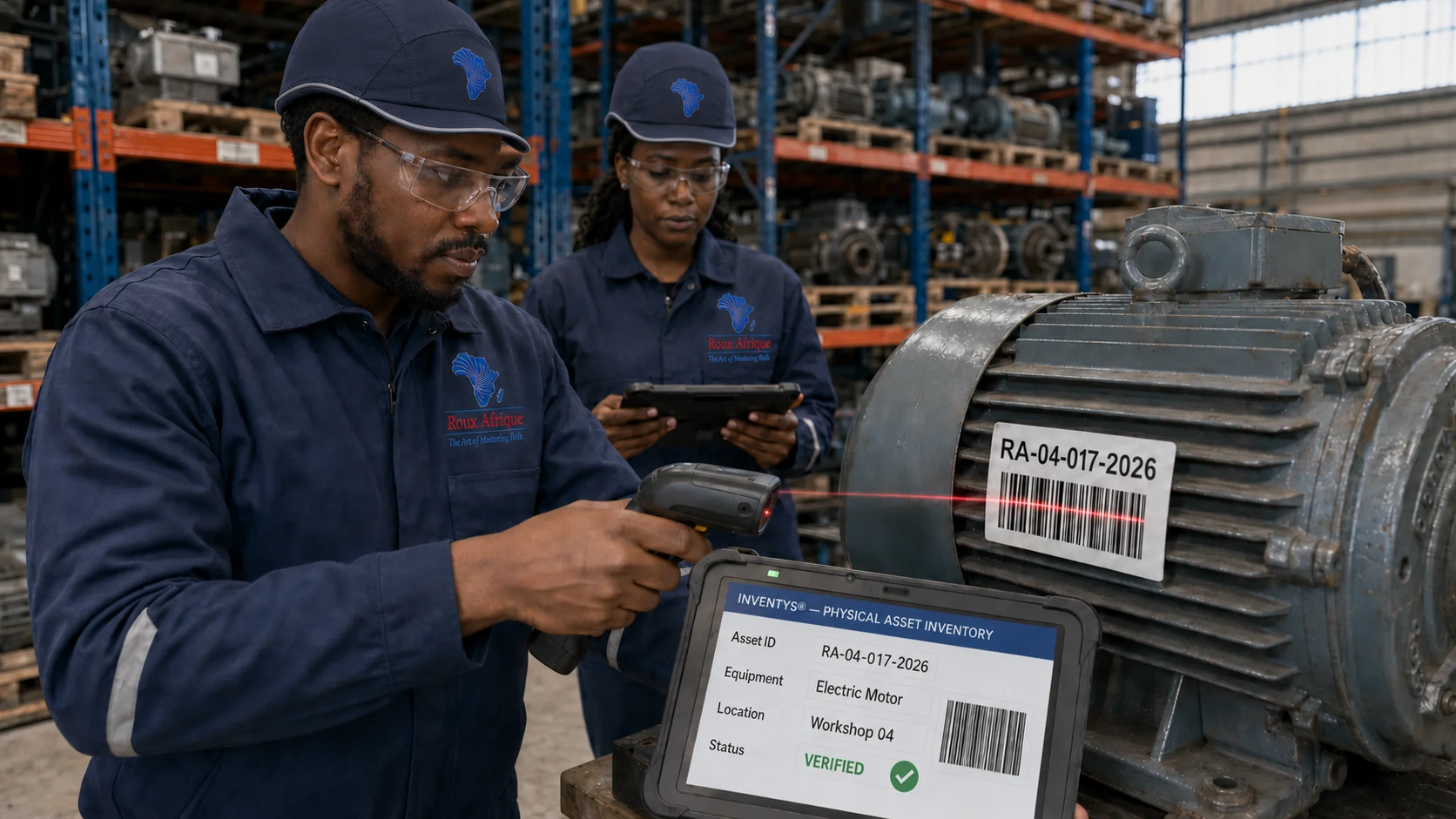
Physical Verification & Asset Tagging
View details
Locate and observe in-scope assets, read nameplates and collect the agreed identifiers, quantities, statuses and evidence.
QR codes, barcodes, RFID or other tagging media are used only where the mandate, environment, security and operating conditions permit.
A tag supports identification. It does not prove legal ownership, accounting recognition or fitness for service.
04
Asset Characterisation & Hierarchy
View details
Document the required attributes: function, manufacturer, model, serial number, capacity, location, parent unit and lifecycle status.
Any condition assessment is limited to a first-level visual observation unless further investigations are expressly included. It does not constitute an operational test or an assessment of integrity, safety or compliance.
05
Reconciliation & Exception Management
View details
Reconcile field reality with the different source systems, preserve historical identifiers and classify discrepancies.
Each match may be one-to-one or require mapping.
one accounting entry to one physical asset
one accounting entry to several items of equipment
several entries to one installation
a field asset with no identifiable source record
a source record with no asset located
06
Master Asset Register & Data Governance
View details
Produce the structured, reconciled Asset Register for the agreed scope, with quality indicators, import mappings and an exception register.
The assignment also defines responsibilities, controls and update triggers so that the register does not become obsolete after fieldwork.
TWO DIRECTIONAL TESTS
Two directional tests. Two different risks.
01
Book-to-Floor
From records to the field
The control starts with entries in the source systems and seeks the corresponding assets on site.
It tests in particular:
physical existence
identity
location
quantity
apparent operating status
consistency of key attributes
On its own, this control cannot identify every physical asset missing from the systems.
02
Floor-to-Book
From the field to the records
The control starts with observed assets and seeks their corresponding entries in accounting and technical systems.
It tests in particular:
register completeness
unrecorded assets
entity or classification errors
inconsistent aggregation or component breakdown
missing or obsolete identifiers
It does not automatically validate ownership, carrying amount or accounting treatment.
A responsible assignment combines both directions and separately documents the population, achieved coverage, inaccessible assets and residual exceptions.
DISTINCT RECORDS
An Operational Asset Register is not a SOV, an Accounting FAR or a CMMS
These records must interoperate without being conflated.
Record
Primary purpose
Physical asset inventory
Documents the existence and observable attributes of in-scope assets at a reference date.
Operational / Master Asset Register
Structures identity, location, hierarchy, status and mappings required for ongoing asset management.
Accounting Fixed Asset Register
Holds the accounting representation of fixed assets, including costs, depreciation and carrying amounts under the company’s rules.
CMMS/EAM
Supports maintenance, work orders, failures, spare parts and maintenance plans.
Statement of Values
Presents values declared for insurance under separately determined valuation bases and structures.
The Operational Asset Register is the data layer used to establish mappings between physical, technical, accounting and insurance realities.
MASTER ASSET REGISTER
A governable Asset Register must go beyond an equipment list
Depending on the mandate, data may be organised around the following families.
01
Identity
View details
unique Roux Afrique or client identifier
legacy identifiers
tag number
standardised description
class and subclass
manufacturer, model and serial number
02
Location and responsibility
View details
declared entity assignment
country, site, building, area and room
functional location
cost centre or operating unit
responsible department or asset custodian
03
Technical hierarchy
View details
parent installation or system
parent asset
component or subassembly
function and service delivered
key technical characteristics
quantity and unit of count
04
Lifecycle and status
View details
acquisition or commissioning date when available
in service
stand-by
idle
under repair
stored
transferred
pending disposal
disposed of or scrapped under a documented decision
05
Financial and insurance mappings
View details
Financial and insurance data are reconciled. They are not automatically audited or valued within the inventory assignment.
Accounting Fixed Asset Register identifier
account, cost centre, project or WBS
cost, currency and carrying amount when provided or validated by Finance
ERP or subledger reference
CMMS/EAM mapping
SOV or valuation-report reference where relevant
06
Evidence and governance
View details
verification date and method
verifier
photograph, scan or documentary reference
reconciliation status
source of each data point
confidence level
exception code
resolution owner
decision and approval
change history
GRANULARITY & ASSET UNIT
The asset unit must be defined before counting begins
The same industrial installation may represent:
one capitalisation entry
several maintainable objects
several accounting components
several insurable assets
one functional system for Operations
The assignment therefore distinguishes:
the physically identifiable object
the functional unit
the maintainable item
the technical component
the unit of account
the insurance declaration unit
Parent-child relationships and components that may require separate analysis are documented.
Component accounting, cost allocation, useful-life and depreciation decisions remain subject to the client’s policies and approvals.
RECONCILIATION & EXCEPTION REGISTER
Exceptions must be classified, not concealed
The Reconciliation & Exception Register may distinguish in particular:
Found and Recorded: asset observed and reconciled
Found not Recorded: asset observed with no matching source record
Recorded not Found: source record with no asset located
inaccessible or not verifiable asset
missing, illegible or inconsistent tag
probable duplicate
serial-number or attribute conflict
incorrect location, entity or custodian
aggregation or componentisation discrepancy
transferred or replaced asset
idle or obsolete asset, or an asset presumed to have been disposed of
fully depreciated asset still in service
insufficiently identified leased or third-party asset
capital work in progress potentially commissioned
addition, transfer or disposal after the cut-off date
An asset not located is not automatically an asset that does not exist. A ‘Recorded not Found’ entry remains open until investigation and a documented decision.
Each exception has a source, available evidence, an owner, a proposed action and a validation status.
No discrepancy automatically triggers an accounting entry, derecognition, scrapping decision or legal conclusion.
EIGHT-STEP METHODOLOGY
An eight-step fieldwork, data and governance methodology
01
SCOPE
Define the purpose, entities, sites, areas, asset classes, reference date, access, exclusions, HSE constraints, responsibilities and deliverables.
The approach—wall-to-wall, targeted, cyclical or sample-based—is explicit. A sample-based inventory is never presented as comprehensive.
02
MODEL
Set the taxonomy, granularity, hierarchy, mandatory fields, statuses, identification rules and required evidence.
03
PREPARE
Collect, profile, standardise and deduplicate source data. Plan field routes, area owners and asset-movement controls.
04
VERIFY
Observe accessible assets and collect the agreed data and evidence in accordance with the protocol.
Access limitations, unvisited areas and non-observable assets are recorded.
05
IDENTIFY & CHARACTERISE
Confirm or apply tags where included, read nameplates and document attributes, locations, parent-child relationships and agreed statuses.
06
RECONCILE
Perform Book-to-Floor and Floor-to-Book controls. Link observations to Finance, Engineering, Maintenance and Insurance records without merging their purposes.
07
VALIDATE
Submit sensitive cases to site and data owners. Document decisions, reservations and unresolved exceptions.
08
TRANSFER & MAINTAIN
Issue the Asset Register, mappings and agreed import files, then formalise the workflow for additions, transfers, replacements and disposals.
Methodological signature
Every reconciled entry must be linked to an identifier, location, source, verification method, date and validation status.
DATA ROOM
A Data Room designed around the assets and systems to be reconciled
Depending on the mandate, requested data may include:
Accounting Fixed Asset Register, subledger and general-ledger extract
chart of accounts, cost centres and capitalisation rules
ERP, EAM, CMMS and data dictionaries
equipment lists and previous inventories
existing SOVs and valuation reports
drawings, layouts, P&IDs, GIS and technical files
acquisition records, invoices and purchase orders
commissioning and handover files and CAPEX projects
capital work in progress
transfer, sale, retirement or scrapping forms
lease agreements and third-party asset lists
tagging, barcode or RFID history
site, building, area and functional-location nomenclature
requirements and formats for future import files
HSE, security, confidentiality and access rules
asset-movement log around the cut-off date
Missing, conflicting or unusable data are recorded in a Data Gap & Assumption Register.
QUALITY ASSURANCE / QUALITY CONTROL
QA/QC designed to make the results defensible
Quality control covers in particular:
alignment between the authorised scope and the processed population
coverage rate by asset count and, where available, by carrying amount
documentation of exclusions and inaccessible assets
uniqueness and stability of identifiers
duplicate detection
completeness of mandatory fields
consistency across entity, site, area, class, cost centre and custodian
integrity of parent-child relationships
link between tag, photograph, location and observation
movement control around the cut-off date
Book-to-Floor and Floor-to-Book controls
targeted recounts and reverification
separation of fixed assets, inventory, consumables and third-party assets
traceability of supplied, observed or inferred data
review of unresolved exceptions
cross-validation by Finance, Operations, Engineering and Maintenance
access rights, confidentiality and retention of sensitive data
version, decision and approval control
independent review before final issue
An assignment cannot be described as comprehensive when the population, access, granularity or exclusions do not support that conclusion.
INVENTYS® & VRA3D
Inventys® and VRA3D supporting a maintainable asset record
Technology structures data and strengthens traceability without replacing field observation or professional judgement.
01
Inventys®
Inventys® supports the structuring of physical, technical, accounting and insurance data used in the assignment.
asset and site hierarchies
identifiers and mappings
sources and reference dates
photographs and evidence
reconciliations
exceptions and missing data
quality indicators
versions
multi-site consolidation
future update cycles
Any interface with an ERP, EAM or CMMS depends on the formats, rules and responsibilities defined in the mandate.
02
VRA3D
Where the site configuration justifies it, VRA3D can provide visual and spatial documentation of areas, installations and critical assets.
equipment contextualisation
understanding physical hierarchies
locating assets in complex environments
technical memory of the site
remote reviews
preparation for future valuation or technical-analysis assignments
VRA3D is used only where it delivers real value. It is not evidence of ownership, an integrity diagnosis or a substitute for field and business validation.
Technology strengthens expertise. It does not replace controls, professional judgement or final validation.
DELIVERABLES
Deliverables designed for use beyond the count
Depending on the mandate:
01Executive Asset Data Reliability Memo
02Physical Inventory Protocol and Report
03Master Asset Register structured and reconciled for the agreed scope
04detailed inventories by entity, site, area and asset class
05Asset Taxonomy, Hierarchy & Data Dictionary
06asset identification convention
07Asset Tagging Register
08photographic record and verification evidence
09field-to-source reconciliation bridge
10Reconciliation & Exception Register
11coverage, completeness and data-quality dashboard
12Data Gap & Assumption Register
13ERP, Accounting FAR and CMMS/EAM mappings
14structured import files where included
15VRA3D documentation where relevant
16data-remediation recommendations subject to client decision
17data governance and maintenance protocol
18RACI matrix
19validated draft and final versions
DECISION POINTS
When should a Physical Asset Inventory & Asset Register assignment be commissioned?
when the Accounting Fixed Asset Register has not been reconciled to the field for several years
before an insurable asset valuation
during an ERP, EAM or CMMS migration or redesign
after an acquisition, merger, carve-out or site integration
after a CAPEX programme or commissioning of a new installation
after transfers, relocations, extensions or closures
before a disposal, financing or M&A transaction
when several databases show material discrepancies
when fully depreciated assets still in service are poorly identified
before multi-site or multinational consolidation
when no consistent identifier or hierarchy exists
before implementing a sustainable asset-movement process
when insurers, auditors, lenders or investors require a better documented asset base
Updates should also be triggered by every material acquisition, commissioning, modification, transfer, replacement, loss, disposal or scrapping event.
SECTORS
Sectors where control of the asset base begins with data
Relevant sectors include:
Energy & UtilitiesOil, Gas & PetrochemicalsMining, Metals & MaterialsIndustry & ManufacturingAgribusinessInfrastructureTransport, Ports & LogisticsTelecommunications & Digital InfrastructureReal Estate, Hospitality & Major PortfoliosHealthcare & Critical ServicesPublic-Sector Groups, Concessions & PPPsInvestors & Multi-site Portfolios
Our experts operate across Africa, the Maghreb and the Middle East, adapting protocols to each site’s access, security, document availability, asset mobility and system-maturity constraints.
CLEAR RESPONSIBILITIES
A responsible mandate. Distinct areas of expertise.
Separately determines valuation bases and reconstruction or replacement values. Inventory data may support quantities and specifications; it does not determine values.
Addresses Insurance Due Diligence, programme architecture, Risk Financing and strategic decisions. Roux Afrique EVS builds the physical and technical data within its mandate.
After a loss, documents and quantifies damage and loss, structures the claim and supports its defence. A pre-existing Asset Register may provide useful data without predetermining ownership, damage or indemnity.
Physical IT or OT equipment may be inventoried when in scope. Logical asset discovery, configurations, vulnerabilities and cyber exposures require a separate Roux Cyber mandate.
08
Accounting Audit & Legal Due Diligence
The assignment does not certify financial statements, legal ownership or IFRS, tax or statutory treatment. Those conclusions remain with the client’s authorised functions, auditors and advisers.
FRAMEWORKS
Frameworks selected according to the mandate’s actual purpose
The engagement letter, client policies, accounting framework, internal procedures and local requirements remain determinative.
01ISO 55000:2024 may inform Asset Management concepts, principles and expected outcomes
02ISO 55001:2024 may inform governance and the asset-management system
03ISO 55013:2024 may support management of data required for Asset Management
04ISO/TS 55010:2024 may inform alignment between financial and non-financial functions
05IAS 16 may inform the interface with recognition, component accounting and derecognition of property, plant and equipment where IFRS applies
06the client’s capitalisation policies, thresholds, taxonomies and data models determine the operational reconciliation rules
IAS 16 prescribes neither a universal Asset Register model, a tagging method nor a physical-inventory procedure.
No generic reference turns the assignment into ISO certification, an IFRS compliance attestation or an audit or assurance engagement over the financial statements.
It is a documented verification of assets within a defined scope, at a reference date and according to an agreed level of granularity.
What is the difference between a physical inventory and an Asset Register?+
A physical inventory records observations at a given date. An Operational Asset Register structures those observations and their mappings in a record designed to be maintained throughout the asset life cycle.
How does it differ from the Accounting Fixed Asset Register?+
The Accounting Fixed Asset Register holds the financial representation of fixed assets. The Operational Asset Register describes their identity, location, hierarchy and status, and establishes the required mappings between systems.
Is the assignment necessarily exhaustive?+
No. It may be wall-to-wall, targeted, cyclical or sample-based. The scope, population, granularity, access, method, coverage and exclusions are explicitly documented.
Does every asset automatically receive a tag?+
No. Tagging depends on the agreed granularity, existing identifiers, operating conditions, security constraints and mandate. Some integrated or difficult-to-access assets cannot be physically tagged.
What happens when an asset is recorded but not found?+
It is classified as an exception. Further investigation and a documented client decision are required before any correction, disposal or derecognition.
How are leased assets, third-party assets, assets under construction and spare parts treated?+
They are treated as separate populations when included in scope. Their physical presence does not establish ownership or accounting classification.
Does the assignment automatically include a valuation?+
No. Any values reproduced in the Asset Register come from identified sources. Their validation or update requires a separate valuation assignment.
Does the inventory certify existence, ownership or the financial statements?+
No. It documents physical observations, mappings and exceptions. It is neither legal evidence of ownership nor an audit or assurance engagement over the financial statements.
Can the register be integrated into an ERP or CMMS?+
Mappings and import files can be prepared when the target systems, formats and rules are defined. Technical integration is included only when expressly stated in the mandate.
How is the Asset Register maintained after the assignment?+
Through a documented workflow covering acquisitions, commissioning, transfers, replacements, modifications, losses and disposals, supported by periodic controls suited to asset volume, risk and mobility.
How are sensitive photographs, plans and location data protected?+
Access rights, collection methods, permitted uses, retention periods and disclosure rules are agreed with the client according to the sensitivity of the sites and data.
RELIABLE ASSET DATA
A sound inventory ends with governance, not a file
Share your sites, existing registers, source systems and intended decisions with us. Roux Afrique EVS will define the appropriate scope, granularity, verification protocol, reconciliation rules and governance model.