Site, surroundings and exposure
Location, operational role, construction, compartmentation, separation, emergency access, neighbours, value concentrations, CAPEX and security.
 ROUX AFRIQUEGROUP
ROUX AFRIQUE EVS · AFRICA & THE MIDDLE EAST
FOR INSURANCE & REINSURANCE
EXPOSURE · PROTECTION · RESILIENCE
A site cannot be reduced to its sum insured or a fire-protection checklist
Roux Afrique EVS provides a documented technical view of operations, processes, critical assets, hazards, safeguards, dependencies, recovery capability and loss scenarios.
Every material conclusion is traceable to the survey date and scope, as well as to documented observations, source records and explicitly stated assumptions.
DECISION-GRADE INFORMATION
A visual inspection alone is not an Engineering Risk Survey.
A defensible assignment connects the site's physical reality, processes, safeguards, operating and maintenance practices, dependencies, potential financial consequences and insurance-programme limits.
STRUCTURED TECHNICAL REVIEW
Location, operational role, construction, compartmentation, separation, emergency access, neighbours, value concentrations, CAPEX and security.
Flows, pressure, temperature, flammables, gas, dust, incompatibilities, ignition, fire, explosion, BLEVE and safe shutdown.
Detection, water supply, pumps, mains, hydrants, hose reels, monitors, sprinklers, deluge, foam, passive protection, testing, maintenance and response.
Critical equipment, rotating machinery, transformers, cables, protection, backup power, controls, condition monitoring, strategic spares and obsolescence.
Flood, coastal surge, earthquake, wind, lightning, ground movement, heat, water stress, wildfire and external infrastructure failure.
Capacity, bottlenecks, dependencies, Single Points of Failure, suppliers, customers, buffers, transfer options, rebuild and ramp-up.
Accountability, work permits, hot work, isolation, contractors, Management of Change, incidents, emergency plans and recommendation tracking.
Insured scope, Statement of Values, PD and BI values, deductibles, limits, sublimits, indemnity periods and scenario consistency.
LOSS SCENARIOS
EML, PML and MFL have no single definition applied uniformly across all markets.
Before calculation, terminology, scope, initiating event, credited or failed protection, values, downtime, mitigation, uncertainty and exclusions are defined.
A severe yet technically credible scenario based on agreed assumptions for safeguards, response and escalation.
A major-loss scenario using the client's or market's definition, identifying every safeguard receiving credit.
A reasonably foreseeable extreme scenario incorporating the agreed protection-failure or unavailability assumptions.
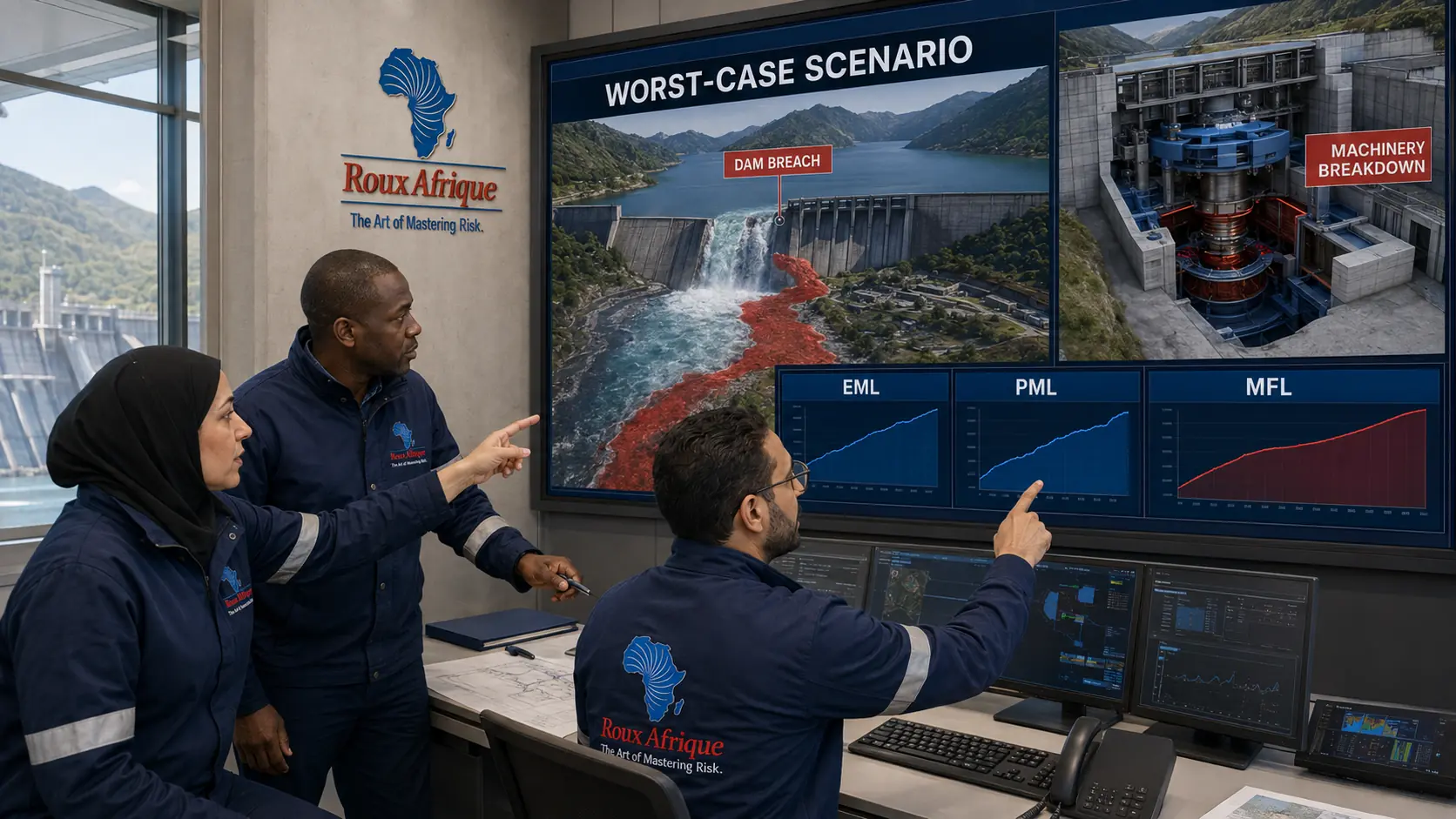
These scenarios are never simple percentages of the sum insured.
METHODOLOGY
Define purpose, users, sites, standards, deliverables and available values.
Review documents, issue the Data Request List and plan visits and interviews.
Document processes, critical assets, utilities, flows and dependencies.
Observe accessible installations, safeguards, practices and available evidence.
Compare statements, documents, history, field observations and tests; record contradictions and limitations.
Make escalation, protection, repair and recovery assumptions explicit.
Rank actions by impact on frequency, severity, downtime and information quality.
Conduct a factual review, complete the independent QA/QC review before issuing the final report and track recommendations where included in the mandate.
Every material conclusion must be traceable to an observation, source document, item of data, assumption or explicitly stated limitation.
EXECUTABLE ACTIONS
An actionable recommendation links the finding and scenario to a verifiable action.
Interim control, restriction, enhanced monitoring or urgent action.
Structural action addressing a material vulnerability or critical barrier.
Measure integrated into CAPEX, maintenance, organisation or continuous improvement.
Cost alone does not determine priority. Closure requires appropriate evidence and may require a new visit for critical actions.
DATA ROOM
Depending on scope, the review may use:
Missing, outdated, conflicting or unverifiable information is recorded in a Data Gap & Assumption Register.
INDEPENDENT QA/QC
The review covers scope, evidence, values, calculations and overall report consistency.
A report must not be described as exhaustive unless the available level of access, testing, documentation, time and expertise is sufficient to support that conclusion.
DIGITAL TRACEABILITY
Technology strengthens expertise; it does not replace controls or professional judgement.
Structures information by site, area and asset.
Provides visual and spatial documentation where authorised.
Inventys® does not convert a statement into verified data. VRA3D is not an integrity test, regulatory certification or substitute for specialist inspection.
DELIVERABLES
Depending on scope:
DECISION POINTS
A previous survey may no longer reflect the current risk. The appropriate review frequency depends on material changes, risk criticality and insurance-programme requirements.
SECTOR EXPERTISE
Teams are selected for the technology, process, location and scenarios under review.
A generic approach cannot replace the required sector expertise.
DISTINCT EXPERTISE
Assesses hazards, vulnerabilities, safeguards, dependencies, technical recovery times and loss scenarios.
Separately determines valuation bases, replacement or reconstruction costs and the Statement of Values.
Establishes insurable gross profit, BI values, financial dependencies and indemnity periods.
Reviews programme architecture, Risk Financing, governance and Insurance Due Diligence.
After a loss, documents and quantifies damage, builds the claim and defends it.
Provides the cyber risk dashboard for insurance and reinsurance and, after a loss, acts exclusively on behalf of the insured as a Cyber Claims Adjuster.
REFERENCES
Local law, contractual requirements, client rules and competent-authority requirements remain decisive.
Reference to a standard is not certification or a comprehensive compliance audit.
Edition, scope and hierarchy are defined for each assignment.
FREQUENTLY ASKED QUESTIONS
A structured review of operations, hazards, critical assets, safeguards, dependencies and loss scenarios supporting prevention and insurance or reinsurance decisions.
HSE focuses mainly on health, safety and environment. The survey focuses on property damage, interruption, value concentration, resilience and insurability.
No. It may review available compliance evidence but does not replace competent authorities or inspection bodies.
Meanings vary by market. Events, safeguards, separation, values and assumptions are defined for each assignment.
An estimate may be prepared with explicit qualifications, a limited confidence level and clearly stated sources, adjustments and uncertainties.
No. It informs technical analysis; acceptance, pricing, capacity and terms remain with insurers and reinsurers.
Only where tests are authorised, planned, safe and included. Otherwise, available installations, records and test results are reviewed.
Desk review can prepare or update selected elements but is not equivalent to field inspection where physical observation is necessary.
No. Insurable asset valuation is a separate assignment, although the work can be coordinated.
The survey identifies scenarios, dependencies and technical periods. Detailed BI values require a specific assignment.
Through review of photographs, certificates, test reports or other suitable evidence; critical actions may require a follow-up visit.
It describes the risk as at a specific date. Material changes to processes, values, safeguards, utilities or dependencies may require an update.
BETTER-EVIDENCED RISK
Share information on your sites, operations and values, together with previous survey reports and the decisions the survey must inform. Roux Afrique EVS will define the required scope, specialist disciplines, Data Room, scenarios and deliverables.
Speak with Roux Afrique EVS